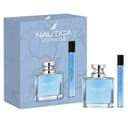
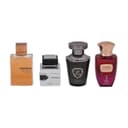
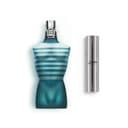
Buy 100 ml of a fragrance you have already worn and loved, and 30 or 50 ml of anything you are still deciding about. The large bottle is nearly always the lowest cost per milliliter, and at roughly 0.10 ml per spray it holds somewhere between 800 and 1,200 sprays — more than a year of daily wear. The small bottle costs more per milliliter and still works out cheaper if the alternative is 100 ml of something you stop reaching for in March.
And the question underneath half the searches on this subject: yes, you can fly with cologne in a carry-on bag, and a standard 3.4 oz bottle is legal. The TSA’s own rule is a quart-sized bag of liquids with nothing over 3.4 ounces (100 milliliters) per container — which the standard large cologne bottle sits exactly at. The 4.2 oz / 125 ml bottle is the one that has to be checked.
The sizes, and what each one holds
US fragrance is sold in a small, stable set of sizes. Converting between ounces and milliliters is where most of the confusion starts, so here is the whole ladder with the spray count attached. The spray figures use a fragrance-packaging manufacturer’s own number — a standard atomizer dispenses about 0.10 ml per actuation, ranging from 0.08 ml to 0.12 ml by brand — so treat them as an honest estimate rather than a guarantee. Nobody prints this on a box.
- 2 ml sample vial— about 20 sprays, or ten days at two sprays a day. Enough to judge a fragrance properly on skin, which a shop blotter cannot do.
- 10 ml travel spray (0.33 oz)— about 100 sprays. Roughly a month of daily wear, and the size that lives in a bag.
- 30 ml (1 oz)— about 300 sprays. The smallest size most designers bother with, and the right size for a scent you are trialling seriously.
- 50 ml (1.7 oz)— about 500 sprays. The sensible default for a second or third bottle in a rotation.
- 75 ml (2.5 oz)— about 750 sprays. Less common, and the size that quietly breaks price comparisons: Swiss Arabian Shaghaf Oud, for instance, is a 75 ml bottle sitting on shelves beside 100 ml competitors.
- 100 ml (3.4 oz)— about 1,000 sprays, and the largest container you can take through airport security. This is the default large bottle and usually the best rate.
- 125 ml (4.2 oz)— about 1,250 sprays. Often the cheapest per milliliter on the shelf, and not flyable in a carry-on.
Two sprays a day is the assumption throughout, because that is the dose we recommend for most of what we rank — see how to apply cologne. If you use four, halve every figure above.
Cost per milliliter is the only honest comparison
Sticker price tells you nothing across sizes, and the industry knows it. The arithmetic is trivial: divide the price by the volume in milliliters. A $90 bottle of 100 ml is $0.90 per ml. A $60 bottle of 50 ml is $1.20 per ml — a third more expensive for the same juice.
Do it before you buy, every time, because the gap is frequently larger than people expect and it is not consistent between brands. It is also the only way to compare across concentrations sensibly: an eau de parfum at $1.20 per ml and an eau de toilette at $0.90 per ml are not the same trade, because published ranges put eau de parfum at roughly 15 to 20 percent fragrance oil against 5 to 15 percent for eau de toilette. More oil per milliliter means fewer sprays needed for the same effect, which our concentrations guide covers properly.
The one place the arithmetic misleads is the value shelf. At the prices the Arabian houses charge, almost every bottle is 100 ml and almost every cost per milliliter is low enough that the difference between two of them is pennies. There, the question is not rate — it is whether you will wear it, which our under $50 list addresses directly.
Why the big bottle is often the wrong buy anyway
Here is the arithmetic nobody does. A 100 ml bottle at two sprays a day is about 500 days of wear. If you own four fragrances and rotate them, each one is getting used roughly a quarter as often — so that bottle now represents five or six years.
Fragrance does not last indefinitely once opened. It oxidizes gradually, and the top notes go first: citrus turns sour before anything else, which is why an old bottle of a bright aquatic smells wrong at the opening and more or less fine twenty minutes in. Three to five years is a reasonable working life for an opened bottle stored sensibly — cool, dark, away from the bathroom radiator. Our does cologne expire guide has the detail, and how to store cologne covers the conditions.
So the honest size rule for anybody with more than two bottles is: 50 ml of everything except your signature. The cost per milliliter is worse and the cost per wearing is better, because you will actually finish it while it still smells like it did when you bought it.
Flying with cologne
The TSA rule is short and worth reading in its own words rather than through a travel blog. Passengers may bring a quart-sized bag of liquids, aerosols, gels, creams and pastes through the checkpoint, limited to travel-sized containers of 3.4 ounces (100 milliliters) or less per item. Anything larger goes in checked baggage.
Three practical consequences:
Your 3.4 oz bottle is fine.This is the part people get wrong in both directions — some assume no fragrance is allowed, others try to carry a 4.2 oz bottle. The standard large cologne bottle is exactly at the limit, so it is permitted, provided it fits in the quart bag alongside your other liquids. In practice a 100 ml bottle takes up a lot of that bag.
The 125 ml bottle cannot fly in the cabin. If you own the 4.2 oz size, it travels in the hold or it stays home. Checked bags have no such limit, but a glass bottle in a suitcase is a risk you are choosing to take.
A 10 ml atomizer solves all of it.About a hundred sprays, negligible space in the quart bag, nothing to break, and no argument at the checkpoint. This is the single best reason to own a travel spray even if you never leave the house with it otherwise — and decants explained covers filling one yourself from a bottle you already own.
One caveat we will state plainly: rules outside the US differ, and the source above is the US regulator only. Check the authority for the airport you are leaving from rather than assuming the 100 ml figure is universal.
So: which size
The decision tree is three questions long.
Have you worn it on skin for a full day?If not, buy a sample or a 10 ml decant, not a bottle. This is the cheapest mistake to avoid and the most commonly made — testing before you buy is the whole method.
Will it be your main fragrance? If yes, 100 ml. Best rate, carry-on legal, and you will get through it before it turns.
Is it the fourth bottle in a rotation? Then 50 ml, or 30 if it exists. You are buying variety, not volume, and the per-milliliter premium is the price of not owning a shelf of half-full bottles that no longer smell right.
Prices in the buy buttons below come from our daily Amazon check and carry the date they were read. Where a bottle returns no live price you will see “check price on Amazon” rather than a number — and for size comparisons specifically, check the listing title: the same fragrance is frequently sold in several sizes under near-identical names.