Before you train: don’t
The question “what cologne should I wear to the gym?” usually has the answer “none, until afterwards.” Three reasons, and none of them is about etiquette for its own sake.
You cannot control the dose once you are warm. Fragrance release scales with skin temperature, and a working body is several degrees warmer at the surface than a resting one. The two sprays that sit politely on you at a desk do not sit politely on you mid-set.
Sweat changes it.Perspiration is slightly acidic and it interacts with the materials on your skin, which is a well-documented reason a fragrance smells different on different people in the first place — our guide on why cologne smells different on you covers the mechanism. Add heat to that and the dry-down you tested at home is not the dry-down you get.
It mixes with everything else in the room. A busy gym already has deodorant, rubber, cleaning product and other people in it. Adding a projecting fragrance to that is not a fragrance decision, it is an air-quality one.
The practical sequence is simple: train, shower, one spray to the chest, dress. That is also why four to six hours of reported wear is a feature on this page — you want the fragrance to cover the commute and the rest of the morning, not to still be on you at midnight.
What to keep in the bag
A full 100 ml bottle in a gym bag is a bad idea for three reasons: weight, glass, and heat. A car boot or a locker in summer gets hot enough to accelerate degradation, and a cologne stored badly turns sour at the top notes first — the same failure mode our storage guide describes.
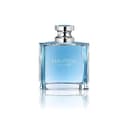
Two better options. Buy a bottle that comes with a travel spray — Nautica Voyage’s two-piece set includes a 0.33 oz one — or decant into a 5 or 10 ml atomizer from a bottle you keep at home. Our travel-size guide covers both routes, and decants explained covers what you are actually buying when somebody sells you a 10 ml vial of something expensive.
Keep the expensive bottles out of it entirely. There is no version of this where a Private Blend in a kit bag is a good allocation of money.
Which materials work in heat, and which fail
Works:citrus (bergamot, grapefruit, lemon), marine and mineral accords, mint, and the herbal materials — rosemary, lavender, artemisia, cypress. These are volatile and read cool; they lift off the skin rather than sitting on it. Every pick on this page is built from that list.
Fails:vanilla, tonka, labdanum, benzoin, oud, tobacco and the amber accords generally. These are heavy and slow, and heat does not make them shorter — it makes them arrive all at once. A warm room is the worst possible venue for the entire winter shelf, which is why none of it appears here.
The overlap with our summer and fresh lists is deliberate and we are not pretending otherwise: the physics are the same problem. The difference is the ranking criteria. Summer rewards a fragrance that survives all day in heat; the gym rewards one that does not outstay its welcome and costs nothing to replace.
Prices in the buy buttons above come from our daily Amazon check and carry the date they were read. Where a bottle returns no live price you will see “check price on Amazon” rather than a number.