Bergamot & Birch

Is Cologne Safe?

What is actually in the bottle, what the FDA does and does not regulate, who reacts and why — and the one sentence on the label that explains why you cannot check for yourself.

By Stephen V.Last updated How we rank

How this is funded: we earn a commission if you buy through our links, at no extra cost to you. It never changes which cologne we recommend, and we’ll tell you plainly when we’d skip one. Full disclosure.

The short answer

For most people, cologne is low-risk, and it has been worn in enormous volume for a very long time without widespread harm. That is the honest headline. But there are two facts worth knowing before you accept it, and both come from the US regulator rather than from us.

First: cosmetics are not pre-approved. The FDA states that the law does not require its approval before cosmetic products go on the market, and that manufacturers carry the legal responsibility for making sure a product is safe. Fragrance is a cosmetic. Nobody checked your bottle before it was sold the way a regulator checks a medicine.

Second: you cannot read the full ingredient list, because the law does not make anyone print it. The FDA explains that fragrance formulas are complex mixtures that are most likely to be trade secrets, and that the Fair Packaging and Labeling Act cannot be used to force a company to disclose a trade secret. That is why the word “Fragrance” at the end of an ingredient list can stand in for dozens of individual materials.

Neither of those means cologne is dangerous. Both mean the honest answer is “low risk for most people, and not something you can verify for yourself” rather than a flat yes.

What is actually in the bottle

Less than people assume. A fragrance is mostly alcohol, with some water, and a relatively small proportion of fragrance oil— the part that smells. The label on the box is telling you how much of the third thing you are getting. Published industry figures put the ranges at roughly:

  • Parfum / extrait:about 20–30 percent fragrance oil.
  • Eau de parfum:about 15–20 percent.
  • Eau de toilette:about 5–15 percent.
  • Eau de cologne:as low as 2–4 percent.

Two useful consequences follow. One, the thing most likely to dry out your skin is the alcohol rather than the perfume — which is why fragrance is a poor idea on broken, freshly shaved or sunburned skin, and why spraying it in your hair is a bad habit. Two, a higher concentration is not automatically riskier in any simple way, but it does mean more of whatever the actual materials are per spray, which is a sensible reason to use fewer sprays of a parfum. Our concentrations guide has the full breakdown of what each label buys you.

The real risk, and it is a boring one

The thing that actually happens to people is contact dermatitis: redness, itching, small bumps or a burning feeling where the fragrance was applied. The FDA acknowledges directly that some components of fragrance formulas have the potential to cause allergic reactions or sensitivities for some people. It is not dramatic and it is not common, but it is the one documented problem rather than a theoretical one.

Three things make it more likely, and all three are avoidable:

  • Applying to compromised skin. Freshly shaved, broken, sunburned or already-irritated skin has lost the barrier that normally keeps materials out. Spraying a high-alcohol product onto it is the single easiest way to provoke a reaction.
  • Repeat daily exposure to one material. Sensitization is cumulative. A fragrance that was fine for a year can start to bother you, which is genuinely confusing when it happens and is not a sign that the bottle has been reformulated.
  • Sun on top of certain citrus materials.Some citrus oils can increase skin sensitivity to sunlight. The practical version of this is simply not to spray a citrus-heavy fragrance on skin that is about to spend the afternoon uncovered in strong sun — put it on clothing instead. If you are shopping in that category, our bergamot roundup is specific about which bottles are genuinely citrus-led and which only open that way.

Here is the uncomfortable part, and the reason the trade-secret rule matters practically rather than philosophically. If you know you react to a specific material, you still cannot scan a label and avoid it, because the label says “Fragrance.” The FDA notes it does not have the authority to require allergen labeling on cosmetics the way it does on food. The workaround the FDA itself suggests is to contact the manufacturer directly — and in practice brands will often answer a direct question about one named allergen even when they will not publish the formula.

Phthalates, in plain terms

This comes up in every conversation about fragrance safety, so here is the regulator’s actual position rather than a summary of the internet’s. The phthalate commonly used in fragrance is diethyl phthalate, or DEP, where it acts as a solvent and fixative. On DEP specifically, the FDA’s stated position is that it does not pose known risks for human health as it is currently used in cosmetics.

We will report that as written, and also flag what it is not. It is a statement about current use, not a permanent guarantee. And DEP is a different compound from the phthalates that generate most of the alarming headlines, which are largely used in plastics rather than perfume — a distinction that gets collapsed constantly and is worth holding onto if you are trying to decide what to worry about.

Who should be more careful

Not everybody carries the same risk, and the groups worth naming are the obvious ones. People with eczema, psoriasis or known contact allergies have the most reason to patch test rather than assume. People with asthma or migraine triggered by strong smells have a different problem from a skin one — it is about airborne concentration, so dose and the size of the room matter more than the ingredient list.

For children, pregnancy and anyone on medication that affects the skin, we are going to decline to give you an answer, because the honest one is that it depends on specifics a website does not know. Ask a doctor, a pediatrician or a pharmacist. What we will say is the one generally applicable thing: applying fragrance to clothing rather than skin removes the contact-dermatitis question entirely while keeping most of the point of wearing it, and it is the sensible default whenever you are uncertain.

And on pets, which turns up in this search constantly: never apply fragrance to an animal, and treat anything more specific as a veterinarian’s question. The sensible household version is to spray in a different room from where animals sleep and eat, let it dry before close contact, and keep bottles somewhere a curious animal cannot knock one over.

What to do instead of worrying

The practical answer to this whole page is a habit rather than a product: buy the smallest quantity of a new fragrance that you can, test it on a small patch of skin, and wear it for a week before you commit to a bottle. That is the step the picks below exist for, and it also happens to be the cheapest way to avoid buying a hundred-dollar bottle you do not like — which is a far more common regret than a rash.
Quick picks

Ranked on notes, concentration, community-reported performance and value. Select a row to jump to the full write-up. We haven’t wear-tested these — here is exactly what we do instead.

#FragranceBest forPrice
1
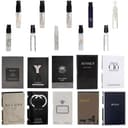
Sampler Set 8 Designer Cologne Samples

Sampler Set 8 Designer Cologne Samples

The cheapest honest way to start. Eight designer vials for less than the price of a single restaurant meal, which is roughly what it costs to find out whether you are a fresh person, a sweet person or a woody person before you spend real money.

Cheapest way to patch test
$21.95 · View on Amazon

Price as of October 18, 2026. #ad How we’re funded

2
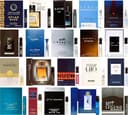
Sampler Set 10 Designer Fragrance Vials

Sampler Set 10 Designer Fragrance Vials

The best entry point on this whole site: ten popular designer vials in one box, so you can find what suits you before committing $80-plus to a full bottle. This is the single most useful thing a beginner can buy.

Best spread to test
$26.99 · View on Amazon

Price as of October 18, 2026. #ad How we’re funded

3
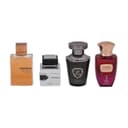
Al Haramain 4-Piece Discovery Set (4 x 10 ml)

Al Haramain 4-Piece Discovery Set (4 x 10 ml)

The most useful spread in this roundup: four 10 ml sprays covering Amber Oud Gold Edition, L'Aventure, Azlan Oud Charcoal Edition and Destino — a sweet amber, a fruity-chypre Aventus alternative, an oud and a fresh. Four genuinely different directions rather than four versions of one idea.

Best for a week-long test
$34.48 · View on Amazon

Price as of October 18, 2026. #ad How we’re funded

The picks in full

#1Cheapest way to patch test

Sampler Set 8 Designer Cologne Samples

The cheapest honest way to start. Eight designer vials for less than the price of a single restaurant meal, which is roughly what it costs to find out whether you are a fresh person, a sweet person or a woody person before you spend real money.

What’s good

  • The least you can spend and still learn something useful about your taste
  • Eight vials is enough range to cover the main directions
  • Small enough to keep in a bag or a desk drawer

Who should skip it

  • Fewer vials than the bigger sets, and less premium packaging
  • Line-up depends on the current listing — check before ordering
ConcentrationSample set
Scent familyAssorted designer
Key notes8 designer cologne samples, Mini fragrance vials
Reported longevityVaries by vial
ForMen

The scent. Eight designer cologne samples in mini vials — the cheapest structured way to try before you buy.

Notes and concentration read from the product listing, on August 11, 2026. Reported performance is community consensus, not our own test.

#2Best spread to test

Sampler Set 10 Designer Fragrance Vials

The best entry point on this whole site: ten popular designer vials in one box, so you can find what suits you before committing $80-plus to a full bottle. This is the single most useful thing a beginner can buy.

What’s good

  • Try ten designer scents for the price of one bottle's shipping
  • The fastest, cheapest way to find your lane
  • Ideal gift for someone starting out

Who should skip it

  • Vials are small — a few wears each, not a season
  • Line-ups vary; check the current listing for what's inside
ConcentrationSample set
Scent familyAssorted designer
Key notesAssorted designer fragrances, Travel-size vials
Reported longevityVaries by vial
ForMen

The scent. A curated box of ten designer sample vials — buy the experience of trying before you spend on a full bottle.

Notes and concentration read from the product listing, on July 19, 2026. Reported performance is community consensus, not our own test.

#3Best for a week-long test

Al Haramain 4-Piece Discovery Set (4 x 10 ml)

The most useful spread in this roundup: four 10 ml sprays covering Amber Oud Gold Edition, L'Aventure, Azlan Oud Charcoal Edition and Destino — a sweet amber, a fruity-chypre Aventus alternative, an oud and a fresh. Four genuinely different directions rather than four versions of one idea.

What’s good

  • Four distinct profiles, not four flankers of the same scent
  • 10 ml each is enough for a fortnight of wear per scent
  • Includes L'Aventure, one of the best-regarded Aventus alternatives

Who should skip it

  • One house's interpretation of each style
  • No packaging designed as a gift — it is a functional box
ConcentrationSample set
Scent familyAssorted Arabian
Key notes4 eau de parfum sprays, 10 ml each, Amber Oud Gold, L'Aventure, Azlan Oud Charcoal, Destino
Reported longevityVaries by scent
ForUnisex

The scent. Four 10 ml eau de parfum sprays — Amber Oud Gold Edition, L'Aventure, Azlan Oud Charcoal Edition and Destino — as listed on the current Amazon set.

Notes and concentration read from the product listing, on August 12, 2026. Reported performance is community consensus, not our own test.

Why sample sets, and not a “hypoallergenic” bottle

We are not going to point you at a fragrance and call it the safe one. There is no meaningful regulatory definition of “hypoallergenic” for a cosmetic, a material that is fine on most people can be the one that bothers you, and a bottle cannot be assessed for your skin by anybody who has not met you. Any site telling you a specific cologne is safe is guessing.

What is genuinely useful is buying the smallest quantity you can before you commit, which is exactly what the picks above are for. The eight-vial box is the cheapest structured way to patch test several different compositions. The ten-vial box gives you more breadth. The four-piece set of 10 ml sprays is the one to reach for if you want to wear a single fragrance for a full week rather than a single day — which matters, because contact allergy frequently needs repeated exposure before it appears, so one quiet afternoon is reassuring rather than conclusive.

Two practical notes to finish on. If a bottle you have worn happily for years suddenly starts to bother your skin, consider the bottle rather than yourself: oxidized fragrance is chemically different from fresh fragrance, and an old bottle can irritate where a new one did not. And if you are buying on a marketplace, counterfeitsare the one unambiguous safety problem in this category — a fake is made to no standard, by nobody accountable, and that is a different kind of risk from the one this page has been discussing.

A note on sensitive skin. Fragrance is one of the most common causes of contact allergy. If your skin reacts easily, spray onto clothing rather than skin and patch-test a new scent on your inner arm first. Nothing here is medical advice.

Frequently asked questions

Is cologne safe to wear?

For most people, yes — fragrance has been worn in volume for a very long time and serious problems are uncommon. But the honest version has two caveats. The FDA states plainly that cosmetic ingredients do not require its approval before going on the market, and that responsibility for safety sits with the manufacturer. And the FDA also acknowledges that some components of fragrance formulas have the potential to cause allergic reactions or sensitivities in some people. So: low risk for most, a real risk for a minority, and not pre-cleared by a regulator the way a drug would be.

What is cologne actually made of?

Mostly alcohol, some water, and a relatively small amount of fragrance oil. The oil percentage is what the label on the box is telling you: published industry figures put parfum at roughly 20 to 30 percent fragrance oil, eau de parfum around 15 to 20, eau de toilette around 5 to 15, and eau de cologne as low as 2 to 4 percent. The rest is the carrier that makes it spray and evaporate. The fragrance oil itself can be dozens of individual materials, natural and synthetic.

Why doesn't my cologne list its ingredients?

Because it does not have to. The FDA explains that fragrance and flavor formulas are complex mixtures that are most likely to be trade secrets, and that the Fair Packaging and Labeling Act is not allowed to be used to force a company to reveal trade secrets. That is why a long ingredient list can end with the single word 'Fragrance' covering dozens of materials. It is legal, it is deliberate, and it is the reason you cannot check a bottle against a known trigger yourself.

Can cologne cause a skin reaction?

Yes, and it is the most common fragrance problem by a wide margin. The FDA acknowledges the potential for allergic reactions and sensitivities to fragrance components. In practice it shows up as contact dermatitis — redness, itching or small bumps where the fragrance was applied — rather than anything dramatic. Two things make it more likely: spraying onto skin that is broken, freshly shaved or sunburned, and repeat daily exposure to the same material. Patch testing a sample first is the cheap way to find out.

Are the phthalates in fragrance dangerous?

The phthalate commonly used in fragrance is diethyl phthalate, or DEP, and the FDA's position on it is specific: DEP does not pose known risks for human health as it is currently used in cosmetics. That is the regulator's own wording and it is what we will report. Note what it does not say — it is a statement about current use rather than a blanket safety guarantee for every phthalate, and DEP is not the same compound as the phthalates that generate most of the headlines.

Is cologne safe for kids?

That is a question for a pediatrician rather than a fragrance site, and we are not going to pretend otherwise. What we can tell you is the relevant fact: children's skin is thinner and more reactive than adult skin, the ingredient list is not fully disclosed, and the FDA does not require allergen labeling on cosmetics the way it does on food — so you cannot check a product against a known trigger. If you are buying fragrance as a gift for a teenager, a lighter eau de toilette applied to clothing rather than skin is the common-sense choice, and our best colognes for teens and young men page is the shortlist.

Is cologne safe around dogs and cats?

Never apply fragrance to an animal, and ask a veterinarian about anything beyond that. Dogs and cats have far more sensitive olfactory systems than people do, and cats in particular metabolize many compounds differently from humans. The practical advice we are comfortable giving is behavioral rather than medical: spray in a different room from where your pets sleep and eat, let it dry before close contact, and store bottles where an animal cannot knock one over and lick it. Anything about specific ingredients and specific animals is a vet question.

Should I spray cologne on my hair?

It is not the best idea, for a boring reason rather than a scary one: cologne is mostly alcohol, and alcohol is drying. On hair that is already dry or color-treated, regular spraying is more likely to leave it brittle than to do anything useful. It will also sit on the surface rather than warming with your skin, so it smells flatter and fades faster. If you want fragrance to last, pulse points and clothing both work better — our guide to applying cologne covers where and how much.

What should I do if cologne irritates my skin?

Stop using it, wash the area, and if the reaction is more than brief redness, see a doctor or dermatologist and take the product with you — they can patch test for the specific material. The FDA's own advice to people concerned about fragrance sensitivities is to choose fragrance-free products and check ingredient lists carefully, or to contact the manufacturer directly to ask about a specific ingredient. Manufacturers will often answer a direct question about a named allergen even though they do not print the full formula.

Sources

Keep reading